Day 18: Pacific Rim
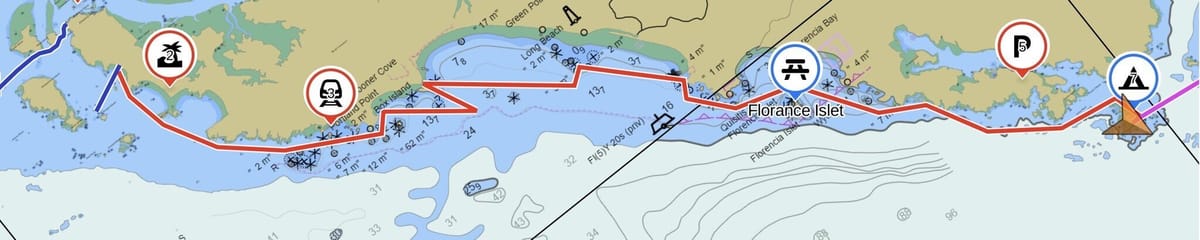
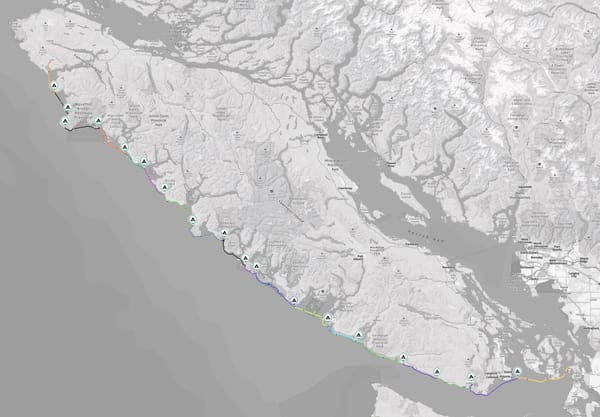
A major day. This trip has always had a difficulty created by the following conditions. Lodging in Tofino is in high demand, expensive, and commonly booked well in advance. The Pacific Rim park makes no accommodations for kayakers. There is no camping for human powered travel with uncertain schedules. Thus we had fixed dates for our stay in Tofino and then had to transition the whole park in one day, a 25nm paddle. The only alternative was to back track to a camp on Vargas Island and wait for favorable conditions for what would then be a 28nm paddle. Our advance plan was to hope for favorable conditions (tail wind) or at least neutral (no wind).
Our plan didn’t work. The forecast looked somewhat like this, which I captured at the end of the day.
Top line is ECMWF, which alone would indicate retreat. But the other, short term higher resolution models disagreed. In the morning those showed more white, more winds under 6kt. I hoped they were right. They should be. They weren’t
Expect moving average of 3.0kt, overall of 2.5 kt. 25nm will take 10 hours. 03:45 alarm, 05:09 launch. Anticipate camp by 15:00.
Soon after launch I notice a light headwind. Not ideal but expected so OK. An hour in I see our speed in about 2.8nt. That will make for a longer day, but OK. We break at Schooner cove, 7pm in. Progress is OK, but less than hopped. More headwind than expected.
We launch, make some progress, but the wind rises to near 15kt and our progress drops to 1.8kt. Wind waves are building. Periodically, and by that I mean way too often, the bow of my boat plunges into a wave, water sweeps along my deck, and my speed drops to 1.0kt. This is too much work.
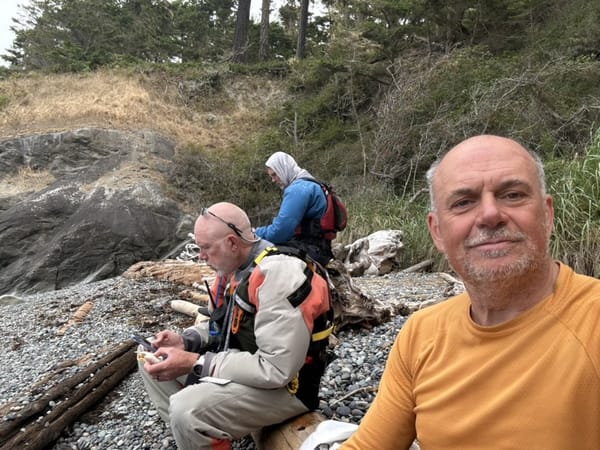
We paddle back to a beach to assess. Opinions differ. David points out the wind is dropping, we can go forward , and thinks we can make it to camp at George Frazier islands. I think the wind has not dropped much, will likely continue all day, and the GF camp is too far. Colin wonders why we are not backtracking to Vargas to wait for reasonable weather. Nelson dislikes the idea of backtracking.
This is what I most feared about this trip: constraints on schedule and camp sites forcing us to choose between bad options. I don’t want to go back, I don’t want to go forward, and we can’t stay here. (likely to be fined if caught, and I think likely to be caught.)
We decide to go forward with the expectation to camp at Half Moon beach. Still within the park and not permitted, but remote and we are unlikely to be found. Next day 7nm into a headwind to GF camp. I don’t think our decision process is good but I’m unable to facilitate a better process. The real problem is that we are choosing from unwanted options. For me, forward is the least unwanted option. I think others feel the same way.
Another 3nm in, half way across the Long Beach bay, the wind has again risen and our progress dropped. We think to land on the shore inside some rocks. The surf is too big, so landing is not an option. Again we must decide between forward or back. 3 nm to a landing then 4nm to Half Moon. Seems possible. Again, we choose the least bad option.
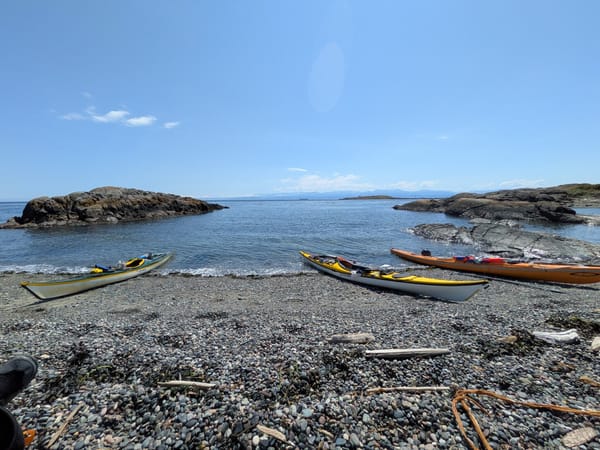
We land and eat lunch. Again David points out the wind has practically died. Again I think that because we are in a protected cove, looking at protected water and the wind is still strong at the point and will continue to blow as it has. At this point Half Moon seems very attainable, retreat too far, and asking the park for help likely to result in a scolding and offer of even worse options. We go on.
The wind is strong at the headland . But as we round Quisitis point I notice our speed is above 3.0kt and the wind is, well, moderate. Passing inside Florencia island the wind is calm (Florencia used to be a camp then the park prohibited camping so it was day use, then the park prohibited any landing. )
Progress is good, the George Fraser camp seems attainable. Camping where we are permitted versus not permitted is appealing. A layover day rather than moving Kampp• with a paddle into the wind is appealing. I call that we should make this decision at the point where we would either turn to half moon or continue to George Frasier.
At that point, I noticed the south wind picking up. I observe that in the time it will take us to paddle the 6 nm to GF Kampp the wind may become strong again. The reasons to continue remain compelling so we continue.
Indeed, the wind picks up. Our speed drops to below to 6nm. The two hour transit has become a 3+ hour transit. We take a break and the protection of a small bay, though it’s little protection. But when we come out, the wind has decreased and progress is better.
In the end, we make it to George Frasier. It’s been 27nm in over 13 hours with three breaks. Most of this done against 5 to 15 winds, in what most would consider storm conditions.
I never worried about our ability to manage the conditions or complete the next segment. We are a very capable group of paddlers.
This is a big day in 2 ways. Primarily, we completed a crux move. From here on we do not have schedule constraints. Secondly, we accomplished a challenging day of paddling.
I feel some satisfaction at the achievement, but I did not enjoy achieving this. For most of the paddle I was physically uncomfortable and mentally uncomfortable. Since I turned 60, I find less enjoyment in pushing very hard, more physical discomfort (joints more than muscles), and feel more fragile, subject to injury. There is a significant gap between what I can do and what I want to/ will enjoy doing.
If I really believed the wind would do what ECMWF predicted (which is what we encountered), I would have chosen to retreat. The other models provided data that (reasonably) supported my preferred (meaning least bad) option. I found it difficult to choose to not when I could.
Constrains on time and options do put pressure on decisions. There is no way to avoid this. One reason to practice using good decision process in a group at all decisionsis so the process is in place when it comes to the difficult decisions.
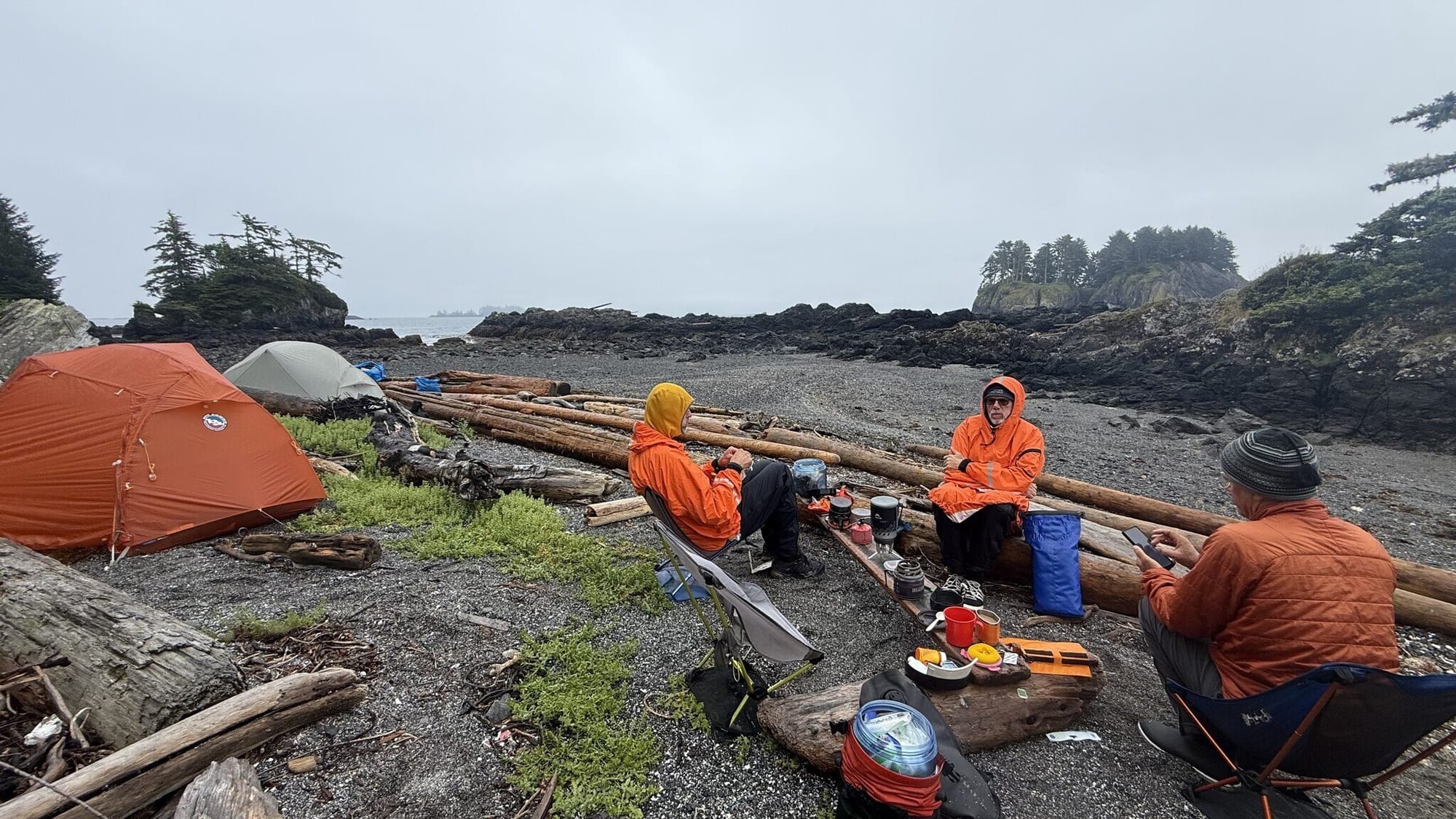
Among an area of constrained camping, George Frazier provides a decent camp that sees little use. The reason for this must be that landing below mid tide is on miserable, slippery large rocks.
My Oura ring game me a score of 100 on my activity
*I dictated some of this message and “Kampp” is how Apple “intelligence “ chose to spell “camp”, despite the obvious context. I got tired of fixing the word. We are now on a kayak Kampping trip.
Will Wade asked what solar panel setup I went with to power the starlink. I thought I would share with everyone. I use devices Will recommend
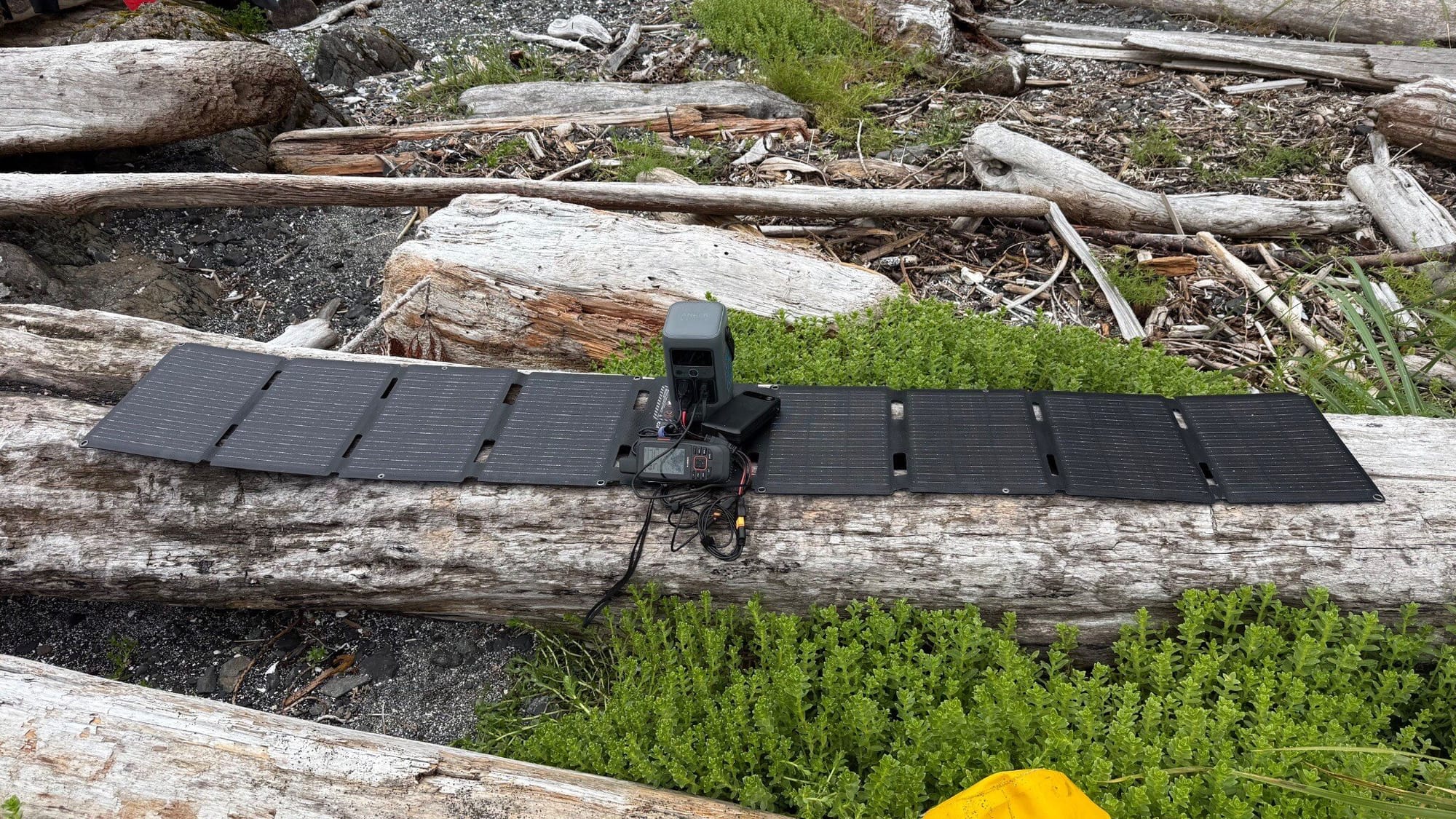
I have 2 EcoFlow 45 watt panels. Both have DC out and I connect them together then into th battery. The panels also have 1 USB C output but Dc is more efficient.
The battery is a Solix C200, 200wHrs. When the panels are in direct sunlight it reports over 60W input. On a cloudy, even rainy day, the panels produce 3 to 10W. Not much but when applied all day it adds up.
Starlink draws 20W. Phones draw 20 to 10W, depending on their state of charge. Smaller devices 2 to 4W. So, on a sunny day I can run starlink, charge a phone and another device or two, and recharge the battery. Because the battery sits between the panels and a phone, the phone can charge at its highest rate without being subject to variability of solar power.
The solix battery can be monitored via Bluetooth from an app on my phone. I scoffed at Will when he mentioned this as a desirable feature. Now I use it all the time.
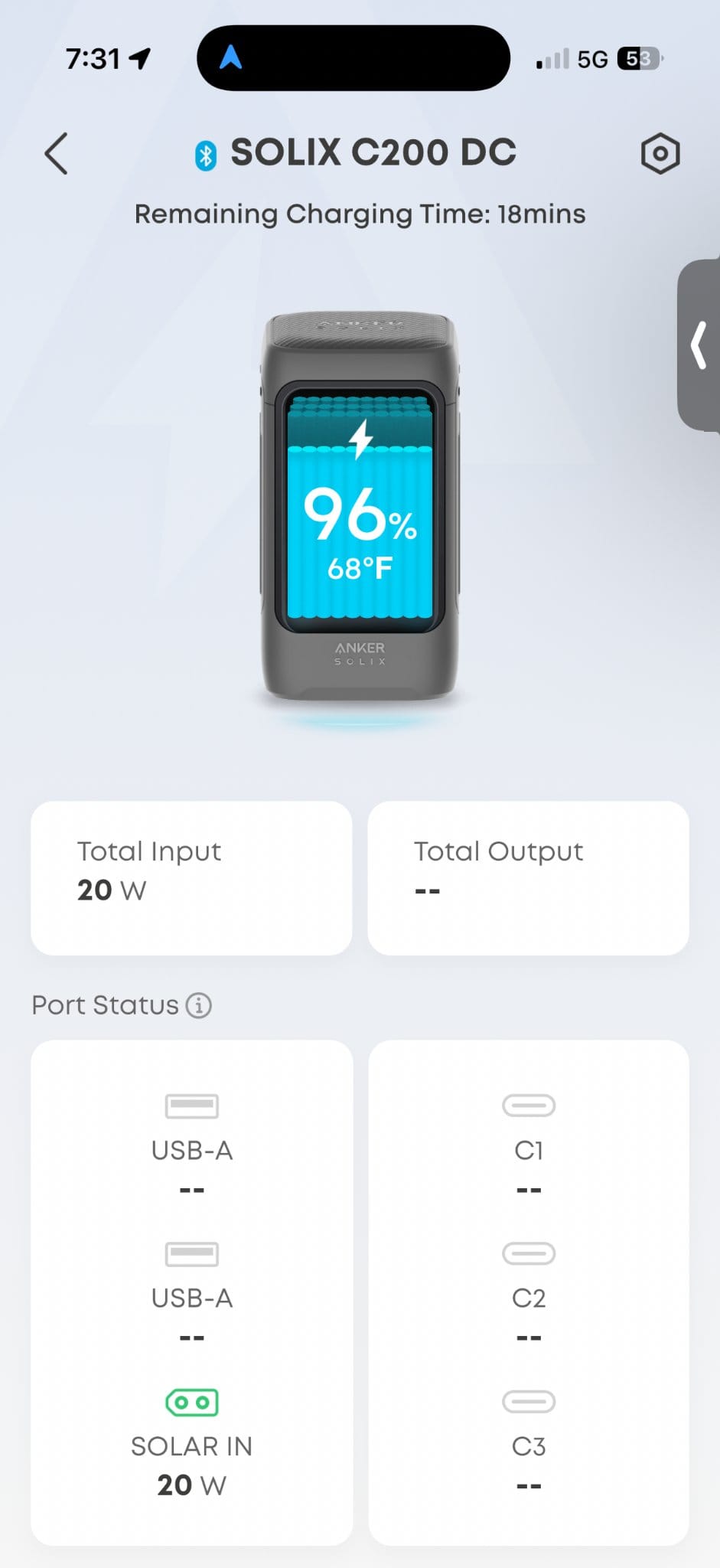
Drawing 20w in diffuse evening light.
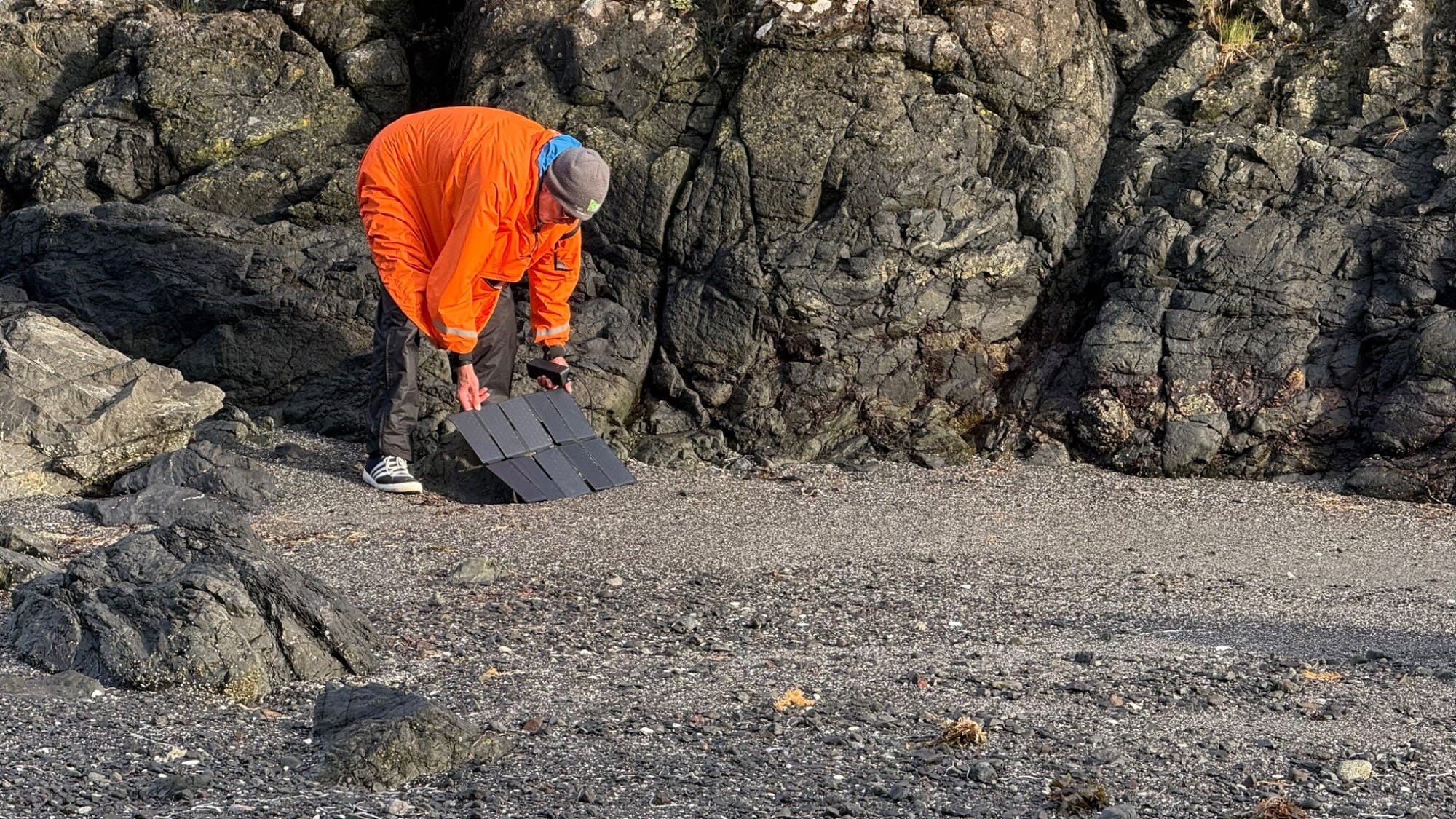
It takes some time to manage this system, but not much mire than others are spending on their solar setup.
The system takes up some space in my boat. The panels and cables fit in a 10L dry bag and the battery and cables in a 5L dry bag. (Colin carries the Starlink, which is too big to fit through my 10” round hatches.
Colin has a BigBlue 35w panel that folds much smaller. It does not have DC out but I might get one, open the electronics, and see if I can wire DC out. That would save some space.
The capacity is more than enough. It has kept my devices (phone, small GPS, headphones, inreach, VHF) and Nelson’s devices charged without the battery falling below 70% and bone 85% most of the time. This through many cloudy days. This means I could have brought a half sized battery and/or only one panel. However, I know Will approves of overkill. And I enjoy the certainty that I can listen to my audiobooks.
I’ll note that as I write this I have watched two eagles flying together, one gull flying high against blue sky, another carrying a tuft of something in its beak, and the crows have moved from creating ruckus near Kampp to ruckus on the nearby island. The sea is calm and I can hear the gentle sound of waves. Islands of the broken group are to my left, some sun lit. We paddle through them tomorrow. Just the outer ones.